Identifying your target programs
MBA Application Timeline: What to Do and When to Apply for 2026-2027
Get a step-by-step MBA application timeline for 2026-2027 to manage deadlines, test prep, essays, recommendations, and interviews before you apply.
Posted August 26, 2026




Join a livestream
Learn from top experts and industry experts in live, interactive sessions you can join for free.


 Oct 19, 2026 at 8:30 PM23 registered
 Oct 21, 2026 at 12:00 AM14 registered
 Oct 21, 2026 at 5:00 PM98 registered

Table of Contents
Knowing when to apply for an MBA can shape the quality of your entire business school application. For most applicants planning to enter an MBA program in fall 2027, the main application deadlines run from September 2026 through April 2027.
The right timeline gives you enough room to research MBA programs, improve test scores, write strong MBA essays, and submit application materials without rushing.
This full MBA application timeline is built for working professionals, international students, reapplicants, and college seniors considering deferred MBA programs. Use it as a planning guide, then confirm the exact requirements and deadlines with every admissions office on your school list.
Key Takeaways
- Most MBA programs use two or three MBA application rounds, but the schedule varies by school.
- Round 1 is a strong choice when your application is ready. Round 2 is also a standard and competitive option at most schools.
- Start preparing 9 to 12 months before your first deadline when possible.
- Take the GMAT or GRE early enough to allow for a retake. Confirm which tests each target program accepts before you register.
- Ask for recommendation letters well before deadlines, especially if your recommenders are current supervisors.
- International students should usually apply in Round 1 or Round 2 to allow time for visa and financial planning.
MBA 2026-2027 Application Deadlines at a Glance
Top MBA programs do not all follow the same schedule. Some have three application deadlines, while others only offer two regular decision rounds.
| Business School | Round 1 | Round 2 | Round 3 |
|---|---|---|---|
| Harvard Business School | September 9, 2026 | January 5, 2027 | Not offered |
| Wharton MBA | September 8, 2026 | January 5, 2027 | March 31, 2027 |
| Kellogg MBA | September 9, 2026 | January 6, 2027 | March 31, 2027 |
| MIT Sloan MBA | September 29, 2026 | January 12, 2027 | Not offered |
These are regular MBA application deadlines for applicants entering the MBA class of 2029. Check each school’s admissions office before you submit because dates, times, essay questions, test policies, and interview schedules can change.
- Harvard Business School MBA: Acceptance Rate, Deadlines, Cost, Requirements, & Program Overview
- The Wharton School MBA: Acceptance Rate, Deadlines, Cost & How to Get In (2026-2027)
- Northwestern Kellogg MBA: Acceptance Rate, Cost, Deadlines & How to Get In (2026-27)
- MIT Sloan MBA: Acceptance Rate, Deadlines, Cost, Requirements, & Program Overview
When Do Most MBA Programs Open Their Applications?
Most MBA programs open their applications in late spring or summer for the following fall intake. Applicants targeting fall 2027 enrollment can expect many top MBA programs to open their applications between May and July 2026, with Round 1 deadlines usually falling from September through early October.
This is why starting early matters. A school may not release its final essay questions until the summer, but you can already make progress on your career goals, school list, resume, test plan, and recommender outreach.
For a list of all the application deadlines for the top business schools, read this: 2026 MBA Application Deadlines of the Top 25 Business Schools.
Understanding MBA Application Rounds
MBA application rounds are not steps you complete one after another. You choose one round for each program, then submit a complete application by that deadline.
| Round | Typical Timing | Best Fit |
|---|---|---|
| Round 1 | September to October | Applicants whose test, essays, resume, and recommendations are ready |
| Round 2 | January | Applicants who need more time to improve their application materials |
| Round 3 | March to April | Applicants with a strong, finished application and a clear reason to apply later |
| Early Decision | Varies by school | Applicants who understand a program’s binding or nonbinding policy before applying |
Round 1
Round 1 can work well for well-qualified applicants who have had enough time to prepare. It may also give international students more time to manage visa requirements after an admission decision.
Do not submit in the first round simply because it is earlier. An unfinished application is rarely stronger than a thoughtful Round 2 application. Your essays, recommendation letters, resume, test scores, and career goals should tell one clear story.
Round 2
Round 2 is not a backup round. It is one of the main MBA admissions rounds at most schools and is a standard admissions round at most schools. It can be the right choice if you need more time for a GMAT retake, school visits, essay revisions, or stronger results at work.
For many applicants starting in late summer or early fall, Round 2 is the more realistic target. Use the extra time to improve the application rather than rushing to submit in September.
Round 3
Round 3 can be more difficult because MBA programs may have fewer seats and less scholarship money available. That does not mean applicants should avoid it in every case. It can still make sense when your application is already strong, you have a major new accomplishment, or a specific school remains a clear fit for your career paths.
Check each admissions team’s guidance before applying. Some programs are more open than others to later-round applicants.
MBA Application Checklist
Download our free checklist for the MBA application used by thousands of applicants to build the strongest application possible without running up against any deadlines
MBA Application Timeline: 12 Months Before Your First Deadline
The first stage of the MBA application process is about making good decisions before you start drafting essays.
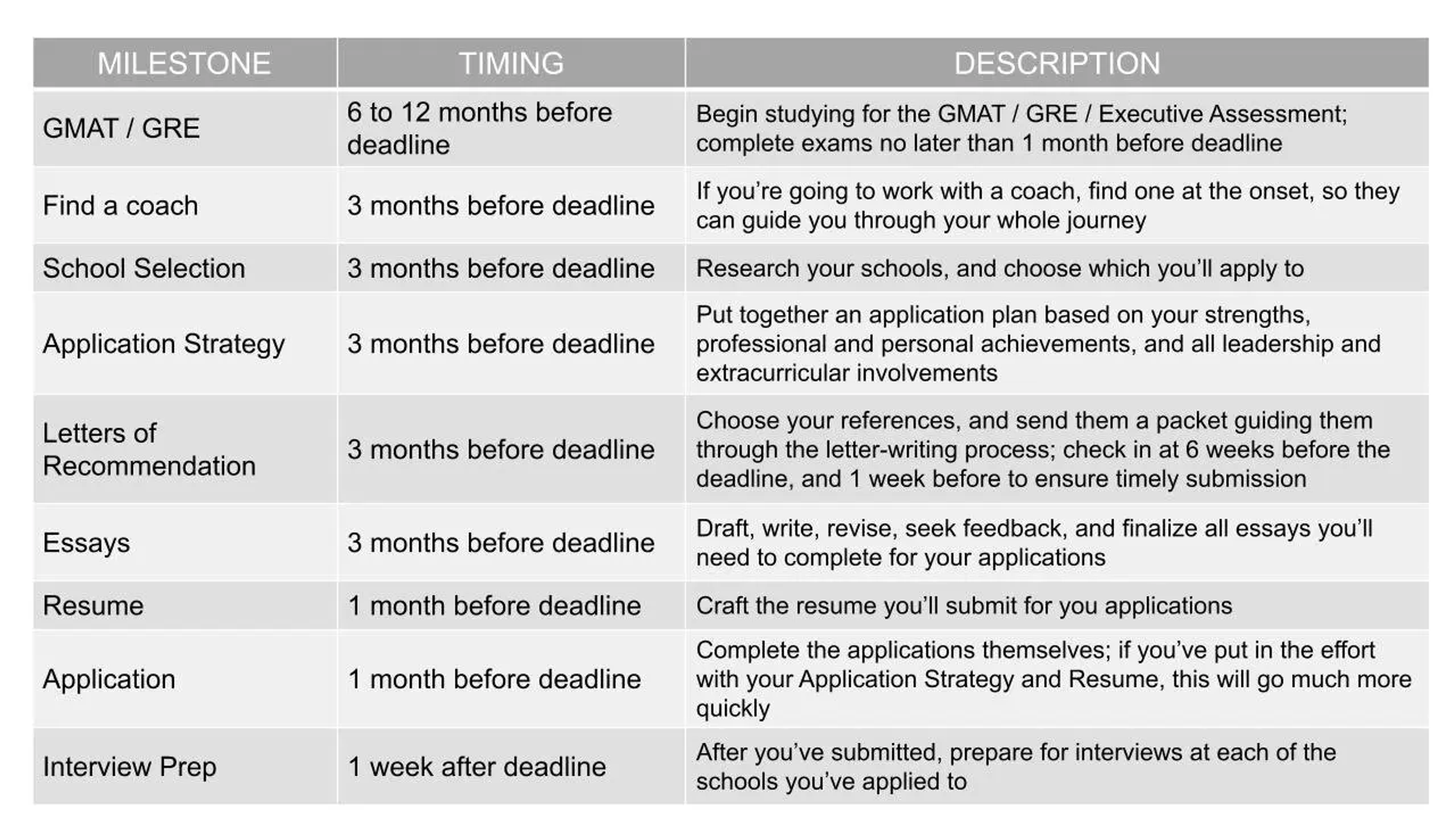
12+ Months Before Your Application Deadline
The first step in your MBA journey is reflecting on whether business school is the right next step for your career. Take the time to define your goals and how an MBA aligns with them.
- Set Career Goals: Clearly define where you want your career to go and how an MBA will help you get there. Think about what skills you want to develop and which industries you want to break into.
- Research MBA Programs: Dive deep into researching MBA programs. Build a list of target schools based on factors like location, curriculum, faculty, job placement rates, and alumni networks. Remember, this is a long-term decision, so focus on finding the programs that truly fit your goals.
- Plan Your Finances: An MBA can exceed $200,000 at top schools. Begin exploring funding options early, such as personal savings, employer sponsorship, scholarships, grants, and federal and private loans. These options can include personal savings and employer sponsorship, among others. It’s never too early to think about how to finance your education.
- Attend Info Sessions and Talk to Alumni: Get a feel for the schools on your list by attending online or in-person info sessions. Networking with alumni and current students will give you valuable insights into the programs you’re interested in. This is also a great way to start building connections.
9 to 12 Months Before Deadline
Now that you’ve decided to pursue an MBA, it’s time to start preparing for the big steps ahead, particularly six months before MBA deadlines.
- Start Studying for the GRE/GMAT: This is one of the most important parts of your application. Start preparing for the GMAT or GRE during the fall or winter before your application deadline. The earlier you start, the more confident you’ll be. Be mindful of program deadlines, says Melissa. Starting early can significantly enhance your chances of success in your MBA applications.
- Consider Working with a Test Prep Tutor: If you’re aiming for a competitive score, consider hiring a tutor. As Melisa Prevost, Senior MBA Admissions Counselor, suggests, “Give yourself ample time for prep, including time for a retake if needed.”
- Outline Your Application Strategy: Think about your application as a whole. This isn’t just about getting the scores; it’s about positioning your story. Caryn Altman, Senior MBA Consultant, advises applicants to start crafting their story early so that they can highlight their unique strengths and experiences throughout their application.
6 to 9 Months Before Deadline
This is the phase where the heavy lifting begins. You’ll finalize your testing and start shaping your application.
- Take Your Test: By this point, you should have your GRE or GMAT scores locked in. Take the test with enough time for a retake, if needed.
- Visit Campuses and Network: Plan campus visits to get a feel for the environment and culture of each school. Attend school-hosted events and network with current students and alumni to get insider insights on what it’s really like to attend.
- Build Your MBA Resume: Start compiling your MBA resume with a focus on leadership experience, professional achievements, and extracurricular activities. An MBA resume differs from a typical job resume, so tailor it to highlight your potential as a future business leader.
- Refine Your List of Target Schools: After conducting deeper research, continue to refine your list. Narrow down your choices based on fit, including culture and post-graduation opportunities.
3 to 6 Months Before Deadline
As your application deadline approaches, it’s time to focus on finalizing your application materials.
- Begin Writing Essays: Start drafting your MBA application essays three months before MBA application deadlines. These essays will form the core of your application, so take your time to reflect on your goals, achievements, and why you’re applying to business school.
- Request Letters of Recommendation: You’ll need to request recommendation letters from mentors or supervisors. Make sure to give them enough time to write strong, thoughtful letters. It’s a good idea to formally ask for recommendations at least three months ahead of the deadline.
MBA Recommender Prep Doc
Download our free recommender prep doc used by thousands of applicants to get the strongest possible letters of rec
- Complete the Application Form: Ensure you complete the application form thoroughly. This often requires detailed biographical and demographic information, along with short-answer questions. Treat the form with intentionality, similar to other aspects of the application process.
- Set Up a Call with a Coach: Work with a coach to finalize your application process plan. Whether you need help with your essays, interview prep, or school selection, a coach can help guide you through each step and provide feedback on your materials.
- Refine Your Application Strategy: This is when you should solidify how each school aligns with your career goals. Be sure you can clearly explain why each program fits your aspirations and how you plan to contribute to the school’s community.
- Prepare for Interviews: Start thinking about interview formats and common questions. While interviews are typically scheduled after submission, it’s helpful to prepare ahead of time.
1 to 3 Months Before Deadline
Now is the time for final revisions and submission prep.
- Finalize Essays, Resume, and Recommendation Letters: This is the final stretch. Spend the last month refining your essays, resume, and recommendation letters. Make sure everything aligns and clearly supports your case for admission.
- Complete the Application Forms: Carefully fill out the online application forms. Be sure to address all short-answer questions in addition to your essays. Double-check your work to ensure accuracy.
- Review Your Test Scores: Check your test scores and decide if a retake is needed. Some applicants find it helpful to retake the test to boost their score.
- Submit Early: If you can, submit your applications early. This gives you a buffer in case you find any issues with your submission or if you need to address any last-minute details.
Manage Waitlist Status: Actively manage your waitlist status if you are waitlisted. Keep schools informed about your progress and accomplishments, and follow the specific protocols set by the schools for communication.
Read: How to Craft the Ultimate MBA Resume—With Examples and MBA Recommendation Letter Guide: Examples, Templates, and Writing Tips
What to Do After You Submit MBA Applications
The application process does not end when you submit.
Prepare for Interviews
Start preparing for MBA interviews before invitations arrive. Some programs send interview invitations soon after the application deadline, while others release them on a published date. Review each school’s admissions timeline so you know when to expect an update, then use the waiting period to prepare.
Your interview should reinforce the story in your application. Be ready to explain why you want an MBA now, why that business school fits your plan, what career goals you are pursuing, and how your leadership experience has prepared you for the MBA class. You should also have clear examples of a difficult team situation, a professional setback, a decision you influenced, and the perspective you would bring to the community.
Practice enough to make your answers focused, but do not memorize them word for word. Admissions teams can tell when an answer sounds rehearsed. A senior MBA admissions consultant can help you improve structure and delivery, but your examples, reasoning, and voice should remain your own.
Read: MBA Interviews: What to Expect, How to Prepare, and How to Stand Out
Manage Waitlists and Updates
If you are waitlisted, follow the school’s instructions. Some admissions teams welcome updates such as a promotion, a higher GMAT score, or a new leadership accomplishment. Others have strict limits on additional materials.
Only send updates that add meaningful information to your candidacy.
MBA Application Timeline for International Students
International students should usually target Round 1 or Round 2. This gives more time for admissions decisions, financial planning, visa paperwork, and relocation before classes begin.
Applicants should also confirm whether they need an English-language test, how official transcripts must be submitted, and whether the school has specific requirements for international academic records.
When Should You Start Your MBA Application?
Start preparing 9 to 12 months before your first MBA application deadline when you can. If you are applying in Round 1, that often means beginning the process the previous fall or winter. If you are targeting Round 2, you still need enough time for test preparation, school research, recommendations, and essay writing.
Applicants beginning later should not assume the cycle is lost. Build a realistic plan around the quality of your application materials. A strong Round 2 application is usually better than a rushed first-round submission.
Work With a Coach to Build a Custom MBA Timeline
The MBA application is made up of several components: standardized testing, essays, resume, recommendation letters, and interviews. Early, says Caryn Altman, a senior MBA admissions consultant, starting the process can alleviate the daunting nature of managing all of them while working full time. Coaches can help you plan each step and avoid mistakes. Working with an expert who understands MBA program deadlines gives you accountability, feedback, and confidence, especially when deadlines are close. Browse the MBA admission coaches here.
Top Coaches
Visit: The 10 Best MBA Admissions Consultants
Read these next:
- Deferred MBA Deadlines 2026: Complete Application Timeline by School
- Best MBA Programs for Entrepreneurship: Top Schools, Rankings, and How to Choose (2026)
- Top 25 1-Year MBA Programs in 2026 (Online & USA Rankings)
- Types of MBA Programs (Exec, Part-Time, Online, 1-Year) & Which One is Right for You
- Why an MBA is the Best Time to Start a Business
- M7 MBA Programs – What They Are & How to Get In
FAQs
When should I apply for an MBA?
- Most applicants should apply in Round 1 or Round 2. Round 1 is a strong option if your application is ready. Round 2 is also a standard choice for applicants who need more time for test scores, essays, or recommendation letters.
Is Round 1 always better than Round 2 for MBA admissions?
- No. Schools rarely publish enough round-level admissions data to prove that one round is always easier. Apply in the round that lets you submit your strongest application. For many applicants, that is Round 2.
How early should I ask for recommendation letters?
- Ask two to three months before your first deadline. This gives recommenders time to write detailed letters and gives you time to follow up before you submit.
When should I take the GMAT or GRE?
- Take your first test early enough to leave room for a retake. For Round 1 applicants, a spring or early-summer test date is often practical. Confirm score-reporting requirements for every school on your list before setting your schedule.
Can international students apply in Round 3?
- They can, but Round 1 or Round 2 is usually more practical because it gives more time for an admission decision, financial planning, visa processing, and relocation.