Types of MBA Programs (Exec, Part-Time, Online, 1-Year) & Which One is Right for You
Executive MBA, part-time, online, or 1-year? Compare all MBA formats, recruiting access, and ROI to choose the right path for your career goals.
Posted March 6, 2026




Join a livestream
Learn from top experts and industry experts in live, interactive sessions you can join for free.
 Starts in 13 minutes26 registered
 Starts in 4 hours32 registered
 Starts in 6 hours18 registered
 Oct 19, 2026 at 8:30 PM17 registered
Table of Contents
If you’re thinking about earning an MBA, you’ve probably noticed there isn’t just one path to a Master of Business Administration. There are multiple types of these programs, each designed for different career goals, life stages, and levels of experience.
Some formats are built for career switchers. Others are ideal for working professionals who can’t pause their income. Some prioritize immersive recruiting; others focus on strategic leadership and executive presence.
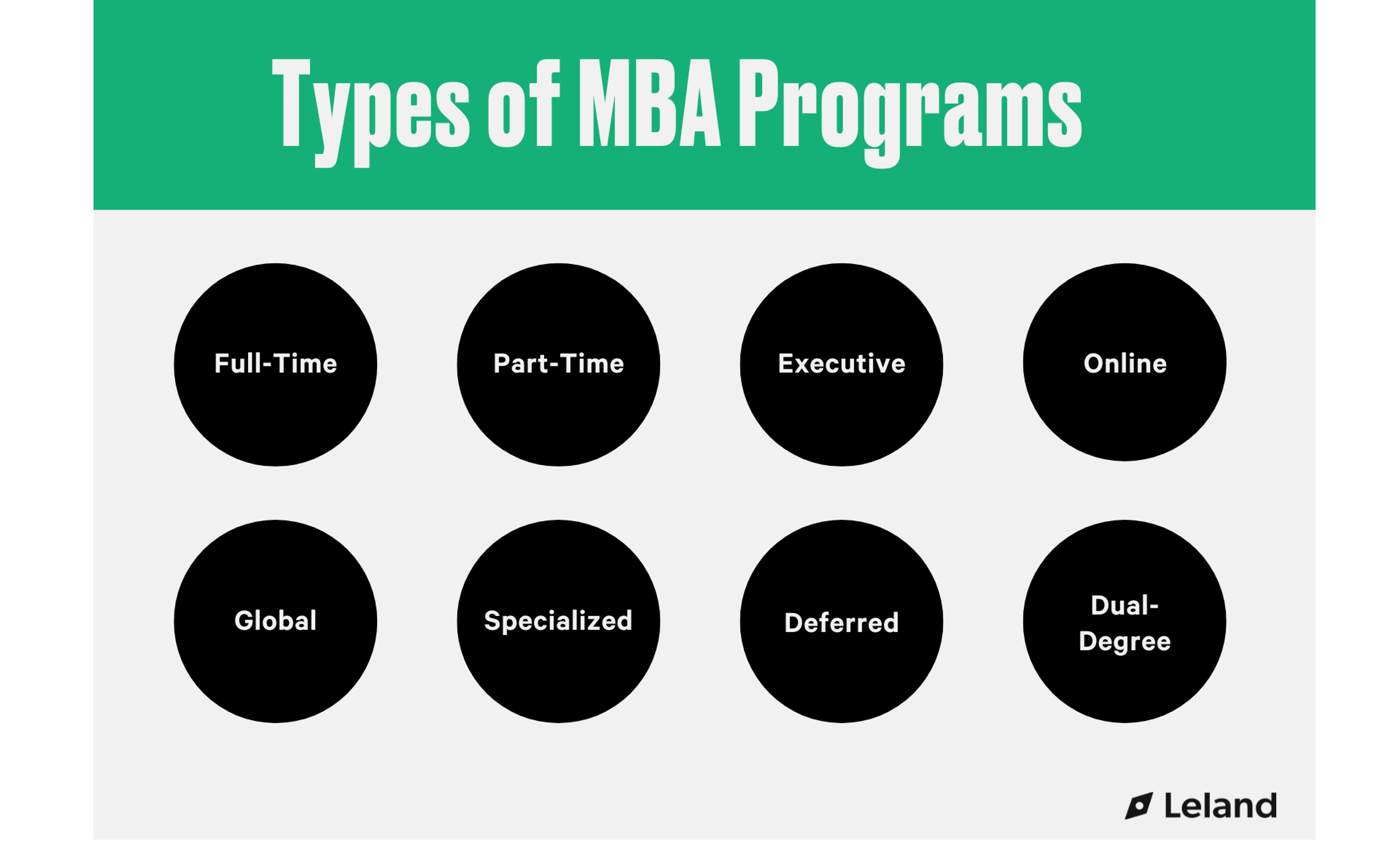
This guide breaks down every major format (full-time MBA, part-time MBA, executive MBA, online MBA, 1-year, global MBA, specialized, and dual degree program options) so you can choose the right one based on outcomes.
The Different Types of MBA Programs
Quick Comparison: Types of MBA Programs
| Format | Who It’s Best For | Internship Access | Work While Studying? | Typical Duration |
| Full-Time MBA Program | Career switchers | Yes (core feature) | No | 2 years |
| 1-Year MBA | Accelerators (not major pivots) | Rare | No | 12 months |
| Part-Time MBA | Career enhancers | Limited–Varies | Yes | 2.5-5 years |
| Executive MBA | Senior leaders | Rare | Yes | 18-24 months |
| Online MBA | Flexible learners | Limited–Varies | Yes | 2-3 years |
| Global MBA | International focus | Yes | Varies | 1-2 years |
If you want to change industries entirely, a full-time MBA program typically offers the strongest recruiting ecosystem.
If you want to grow where you are without stepping away, a part-time MBA or online MBA may make more sense.
If you’re a senior leader aiming for C-suite roles, an executive MBA program is often the right vehicle.
Now let’s break down each of these MBA programs in detail.
Full-Time MBA Program
- A full-time MBA program is the most traditional and immersive type of MBA. Offered by nearly every top business school, this format is designed for students who can step away from work and fully commit to earning their MBA degree in a structured, on-campus environment.
Most full-time MBA programs span two academic years. During the first year, students complete a rigorous core business administration curriculum covering financial accounting, financial analysis, marketing management, strategic management, operations and supply chain management, organizational behavior, and business analytics. This foundation is designed to build strong business knowledge and business acumen across all major functional areas.
Between the first and second years, students typically complete a summer internship. For those pursuing a new career path, especially in consulting, investment banking, technology, or healthcare management, the internship is often the most important recruiting gateway of the entire MBA experience.
In the second year, students choose elective courses and MBA concentrations aligned with their career goals. Many programs allow specialization in areas such as project management, supply chain management, human resources, general management, business analytics, or healthcare administration. This flexibility allows full-time MBA students to tailor their business education to the evolving job market.
A full-time MBA program may be the right fit for you if…
- You are making a significant industry or function pivot
- You want access to structured on-campus recruiting (OCR)
- You value immersive leadership development
- You can pause your income to attend school full-time
- You want deep engagement with classmates, faculty, and alumni
- You are targeting competitive post-MBA roles with strong median annual salary outcomes
Among all types of MBA formats, the full-time MBA remains the strongest option for candidates seeking transformational change rather than incremental advancement.
Example: Stanford Graduate School of Business
The Full-Time MBA Program at Stanford:
- Over 100 Tenure-line faculty members
- Over 150 industry practitioners
- 100+ electives
- Small, leadership-focused cohort model
- Two-year structure with first-year foundations and second-year electives
- Strong integration of experiential learning and leadership labs
- Close ties to Silicon Valley and innovation ecosystems
- Global experience requirement
Core Courses:
- Data Analysis and Decision Making
- Leading with Values
- Finance I
- Financial Accounting
- Leadership Laboratory
- Managing Groups and Teams
- Microeconomics
- Optimization and Simulation Modeling
- Organizational Behavior

1-Year MBA (Accelerated MBA) Programs
A 1-year MBA program, often called an accelerated MBA, condenses the traditional full-time MBA experience into a shorter timeframe, typically 10 to 12 months. These MBA programs are designed for professionals who want to earn their MBA degree quickly without committing to a two-year format.
Unlike a traditional MBA program, a 1-year MBA typically eliminates the summer internship and compresses coursework into an intensive academic calendar. Students still complete a rigorous core curriculum covering finance, marketing management, strategic management, business analytics, and operations, but there is less time for exploration, networking breadth, and elective experimentation.
Because of the accelerated pace, this format works best for candidates with clear career goals who do not require structured internship recruiting to pivot industries.
A 1-year MBA program may be right for you if…
- You plan to stay in the same industry or function.
- You already have strong professional momentum.
- You do not need a summer internship to transition roles.
- You want to minimize opportunity cost and return to the workforce quickly.
- You are seeking a faster path to a graduate degree in business management.
- You are comfortable with an intensive academic schedule.
For professionals focused on acceleration rather than reinvention, a 1-year MBA can be a cost-effective way to strengthen leadership skills and expand business knowledge without stepping away from the job market for two full years.
Read: The 25 Best 1-Year MBA Programs
Example: Duke University Fuqua School of Business
The Accelerated Daytime MBA at Duke Fuqua:
- 10-month accelerated format
- Designed for candidates with prior business coursework
- Bypasses core courses in foundational business administration topics
- Immediate access to elective courses and MBA concentrations
- Full access to Fuqua career resources and alumni network
Core Courses (advanced/elective-focused model):
- Corporate Finance
- Competitive Strategy
- Marketing Strategy
- Business Analytics
- Operations Management
- Leadership and Ethics
- Global Institutions and Environment
Part-Time MBA Program
- Are you interested in earning your MBA degree but don’t want to step away from your career? A part-time MBA program allows students to continue working while completing their MBA, offering flexibility without sacrificing professional momentum.
Part-time MBA programs typically offer:
- Evening sections
- Weekend classes
- Hybrid MBA programs with in-person and online components
These programs are specifically designed for working professionals balancing demanding roles, busy schedules, and other commitments. Most part-time MBA programs can be completed in 2.5 to 5 years, depending on course load and pacing.
Read: Part-Time vs. Full-Time MBA Programs: Pros, Cons, and How to Decide
In 2026, some top MBA programs now allow part-time students to access portions of full-time recruiting. However, this varies widely by business school.
From real-world applicant insights, one factor determines ROI more than anything else:
“Does the program give part-time students the same recruiting access as full-time MBA students?”
If the answer is yes, the value increases dramatically. If not, the MBA studies primarily enhance advancement within your current company rather than enabling a major career pivot.
A part-time MBA program may be right for you if…
- You want to continue working while pursuing your graduate degree.
- You need flexibility to manage work, studies, and personal responsibilities.
- You want to apply classroom learning immediately to your current role.
- You’re aiming to advance within your organization rather than completely change industries.
- You value employer sponsorship opportunities.
You want to build a network of experienced professionals across industries.
In today’s competitive job market, a part-time MBA can deliver strong outcomes, particularly for professionals pursuing steady advancement rather than transformational change.
Example: University of Chicago Booth School of Business
The Part-Time MBA Program at Booth:
- Part-time Evening and Weekend programs offered
- Typically completed in 2.5-3 years
- 20 courses to complete the degree, 130+ to choose from
- 14 concentrations to choose from
- 25% of the courses can be taken remotely
- Start in Fall, Winter, Spring, or Summer
Core Courses:
- Accounting
- Microeconomics
- Statistics
- Leadership Exploration and Development (LEAD)
- Finance
- Marketing
- Operations
- Strategy
- Decisions, People, and Economy
Executive MBA Program
An Executive MBA program, or EMBA program, is a specific type of MBA designed for seasoned professionals with substantial leadership experience. Unlike other MBA programs, executive MBA programs assume participants are accelerating upward rather than pivoting careers.
Most executive MBA programs are structured for professionals with 10-15 years of experience who currently hold leadership roles. Employer sponsorship is common but not required.
Classes are often delivered in modular formats, including:
- Alternate weekend sessions
- Intensive residencies
- Global immersion modules
The curriculum emphasizes:
- Strategic leadership
- Advanced operational management
- Enterprise-level decision-making
- Executive communication
- Global macroeconomics
- Corporate finance
- Advanced business analytics
Because executive MBA programs typically do not include internships, they are best suited for leaders focused on scaling impact within their organizations or preparing for board-level responsibilities.
An executive MBA program may be right for you if…
- You have significant managerial experience and want to refine your leadership skills.
- You are preparing for C-suite or enterprise-level roles.
- You want to expand your strategic management capabilities.
- You prefer learning alongside other senior leaders.
- You want minimal disruption to your current executive responsibilities.
- You are focused on long-term strategic leadership rather than entry-level recruiting pipelines.
For experienced leaders seeking high-leverage professional development, an executive MBA can be one of the most powerful formats among the different types of MBAs.
Example: The Wharton School
The Executive MBA Program at Wharton:
- Campuses in Philadelphia, San Francisco, or remote (Global cohort)
- 200+ electives, 4 majors, 700+ contact hours, 6 terms of study (22-24 months)
- 19 total credits, 10 core credits, 9 elective credits
- 12 years of average work experience
- Classes on alternate Friday/Saturday weekends
Core Courses:
- Leadership Essentials
- Foundations of Teamwork and Leadership
- Management Communication
- Responsibility in Global Management
- Analytic Foundations
- Microeconomics for Managers
- Regression Analysis for Business
- Managing the Productive Core of the Firm: Business Analytics
- Business Foundations
- Managing the Productive Core of the Firm: Operations Strategy
- Managing the Productive Core of the Firm: Quality and Productivity
- Fundamentals of Financial and Managerial Accounting
- Corporate Finance
- Macroeconomics and the Global Economic Environment
- Managing the Enterprise
- Marketing Management
- Marketing Strategy
Online MBA Program
Another flexible option for working students is an online MBA program, especially for those unable to relocate to a business school campus. Online MBA programs deliver the same MBA degree while offering greater flexibility through digital platforms.
Many online MBA programs in 2026 include:
- Live virtual sessions
- Asynchronous online learning
- In-person residencies
- Global immersion experiences
For working professionals, this format removes geographic constraints and allows students to maintain income while advancing their education.
However, recruiting access varies significantly across programs. Some online MBA programs integrate students into structured career pipelines, while others emphasize self-directed career development.
- An online MBA program may be the right fit for you if…
- You require maximum geographic flexibility.
- You need to maintain full-time employment.
- You are comfortable learning in a digital environment.
- You want to strengthen your credentials for promotion.
- You are pursuing advancement in fields such as project management, human resources, healthcare management, or business analytics.
- You want access to a broad peer network without relocating.
Read: Cheapest Online MBA Programs to Level-Up Your Career
Example: University of Michigan Ross School of Business
The Online MBA Program at Ross:
- 24.75 core credits, 17.25 elective credits
- 14-week, 6-credit Multidisciplinary Action Projects (MAP) course required
- Start in the Fall or Winter, asynchronous and synchronous study
- In-person residencies for learning experiences
- Optional in-person electives, on-campus courses, and dual-degree programs
Core Courses:
- Financial Accounting
- Managerial Accounting
- Multidisciplinary Action Projects
- Applied Microeconomics
- Business Law and Ethics
- Financial Management
- Marketing Management
- Human Behavior & Organizations
- Strategy
- Competing in Global Business
- Applied Statistics
International/Global MBA Program
Most international MBA or global MBA programs are designed for professionals seeking careers in international business and multinational leadership. A global MBA emphasizes cross-border strategy, exposure to global business practices, and immersion in international markets.
These programs often include:
- Study-abroad components
- International consulting projects
- Language tracks
- Rotations across global campuses
An international or global MBA program may be the best fit for you if…
- Your career goals involve multinational corporations or global expansion.
- You want deep exposure to international business environments.
- You are interested in global supply chain management and cross-border strategy.
- You want to develop cross-cultural communication and negotiation skills.
- You value international mobility in your long-term career path.
Example: University of South Carolina Darla Moore School of Business
The International MBA Program at Darla Moore:
- 22 months long, begins in July
- Global Track or Language Track (includes language study)
- Core curriculum, international business electives, and in-country experiences
- 10-15 week internship at a multinational company
Core Courses:
- Quantitative Methods
- Financial Accounting
- Leading Teams & Organizations
- Global Strategic Management
- Managing the Multinational Enterprise
- Comparative Institutional Systems
- Global Supply Chain
- Global Finance
- Global Marketing
- Managerial Accounting
- Introductory Language Training
Specialized MBA Program
Many MBA programs allow students to specialize in an area of business, such as finance, business analytics, human resources, and healthcare management. Specializing in one field allows students to spend more time focusing on their prospective career areas and demonstrate knowledge and interest to future employers.
Popular MBA concentrations in 2026 include:
- Healthcare management
- Healthcare administration
- Supply chain management
- Project management
- Human resources
- Human resources analytics
- Business analytics
- Marketing research
- Digital advertising
- General management
- Financial analyst track
- Strategic leadership
- Public administration
A specialized MBA program may be the best fit for you if…
- You have a clear career focus in a specific industry or technical field, such as technology, healthcare, or finance.
- You're seeking to deepen your expertise in a particular area with a curriculum tailored to your interests and career goals.
- You value the opportunity to learn from faculty and industry leaders who are experts in their fields.
- You're looking for a program that integrates business fundamentals with specialized technical skills.
- You aim to stand out in the job market with a unique skill set that bridges the gap between business and technology.
- You're interested in accessing resources, networks, and opportunities specific to your chosen industry.
- You prefer a learning environment that fosters innovation and entrepreneurial thinking in a specialized context.
Students pursuing healthcare management may aim for roles as health services managers, a field with strong projected growth and competitive median annual salary benchmarks. Specializations help students build specialized skills aligned with their intended business career and evolving job market demands.
Example: NYU Stern Andre Koo Technology & Entrepreneurship MBA
The Tech MBA at NYU:
- 1-year program, from May to May
- 52 credits, including Business/Tech Core, immersion, electives, and a project
- STEM-designated degree program
- “Stern Solutions” experiential learning opportunities
Core Curriculum:
- Business Core
- Leadership
- Economics
- Marketing
- Business Communication
- Corporate Finance
- Accounting
- Strategy
- Professional Responsibility
- Tech Core
- Technical Product Management
- Dealing with Data
- Tech Evolution and Economics
- Foundations of Networks and Mobile Systems
- Entrepreneurship
- DevOps and Software Engineering
- Business Analytics

Deferred MBA Programs
A deferred MBA program allows undergraduate seniors and select master’s students to apply to MBA programs before gaining full-time work experience. If admitted, students secure a future seat in the MBA program and then work full-time for several years before enrolling.
Most deferred MBA programs require students to matriculate after gaining 2-5 years of professional experience, depending on the business school’s policy. During this deferment period, students build real-world experience that strengthens their leadership perspective before beginning their MBA studies.
Deferred admission has become increasingly popular among top MBA programs as schools seek to identify high-potential candidates early in their career trajectory.
Unlike traditional MBA applicants, deferred candidates apply directly from college or graduate school and are evaluated based on academic performance, leadership potential, internships, and long-term career goals rather than full-time work experience.
A deferred MBA program may be the right fit for you if…
- You are an undergraduate or master’s student without full-time professional experience.
- You want the security of guaranteed MBA admission early in your career.
- You plan to gain 2-5 years of meaningful work experience before enrolling.
- You want flexibility to explore industries, startups, or competitive roles without reapplying later.
- You are thinking long-term about your leadership development and business education.
- You value joining a cohort of similarly ambitious early-career professionals.
- You want optional access to pre-MBA networking, mentorship, or programming offered during deferment.
For students with strong academic records, leadership experience, and clear long-term vision, a deferred MBA program can be a strategic way to secure a future graduate degree while building momentum in the workforce.
Read: Top 10 Deferred MBA Programs in the US—and How to Get In
Example: Northwestern Kellogg Future Leaders Deferred Enrollment Program
The Future Leaders Program at Kellogg:
- No application fees, no GMAT/GRE required
- Application includes essays, letters of recommendation, and an interview (by invitation only)
- Deferment lasts 2-5 years
- Admissions deposit is $500, then another $500 for every year of deferment
- Once matriculated, you are the same as the traditional, full-time MBA candidates
Core Curriculum:
- Leadership in Organizations
- Business Strategy
- Finance I
- Marketing Management
- Microeconomic Analysis
- Business Analytics I
- Business Analytics II
- Operations Management
- Financial Accounting
- Leadership & Crisis Management

Dual-Degree MBA Programs
Many business schools also offer dual-degree programs in partnership with other graduate schools for students interested in multiple fields. These programs combine an MBA with another graduate credential, allowing students to earn two complementary degrees in an accelerated timeframe compared to pursuing them separately.
- Common dual degree options include:
- JD/MBA (law and business)
- MD/MBA (medicine and healthcare leadership)
- MBA + Engineering (technology and innovation management)
- MBA + Public Administration or Public Policy (government and nonprofit leadership)
Most dual degree programs take three to five years to complete, depending on the structure and credit sharing between schools.
These programs are designed for students pursuing highly interdisciplinary career paths, such as healthcare administration, regulatory strategy, biotech entrepreneurship, infrastructure investing, public-sector leadership, or corporate law.
Rather than deep specialization in a single functional area, dual degree students develop cross-functional fluency, combining business management training with technical, legal, medical, or policy expertise.
A dual degree program may be right for you if…
- Your long-term career goals sit at the intersection of business and another regulated or technical field
- You want formal credentials in both domains
- You’re willing to commit additional time and tuition for expanded optionality
- You’re targeting leadership roles that require both domain expertise and executive decision-making
For candidates aiming to lead complex organizations( hospitals, law firms, engineering-driven companies, or public institutions), a dual degree program can provide both strategic leadership training and subject-matter credibility.
Read: The Top MS/MBA Dual-Degree Programs and How to Get In
Example: Harvard Business School
- JD/MBA with Harvard Law School
- MBA/DMD with Harvard School of Dental Medicine
- MBA/MPP with Harvard Kennedy School
- MD/MBA with Harvard Medical School
- MS/MBA in Engineering Sciences with Harvard School of Engineering and Applied Sciences
- MS/MBA in Biotechnology: Life Sciences with Harvard Graduate School of Arts and Sciences
Which MBA Program Is Right for You?
Instead of asking one question, think in layers:
- Career objective
- Financial constraints
- Seniority level
- Recruiting dependency
- Geographic ambition
- Risk tolerance
Below is a detailed, expert-level decision matrix you can use to identify the right type of MBA for your situation.
| Decision Factor | If This Sounds Like You… | Recommended MBA Format | Why This Format Wins | What to Double-Check |
|---|---|---|---|---|
| Industry Pivot (Hard Reset) | “I want to switch industries or functions entirely (e.g., engineering → consulting, nonprofit → IB).” | Full-Time MBA Program | Structured recruiting, summer internship, strong OCR pipelines, immersive career support | Internship access, industry placement data, geographic recruiting strength |
| Career Acceleration (Same Industry) | “I want faster promotion and broader leadership responsibility.” | Part-Time MBA or Online MBA | Immediate application to work, no income loss, employer sponsorship potential | Does the program offer equal career resources? Alumni strength in your company/industry |
| Senior Leadership / C-Suite Track | “I already manage teams or divisions and want enterprise-level strategy skills.” | Executive MBA Program | Peer group of seasoned professionals, strategic leadership focus, modular schedule | Average years of experience, employer sponsorship norms, and global modules |
| Entrepreneurship / Start Your Own Business | “I want to launch or scale my own business.” | Full-Time MBA or Select Executive MBA Programs | Access to venture ecosystems, startup incubators, and funding networks | VC pipeline, accelerator programs, and alumni founder density |
| Global Career Ambition | “I want multinational exposure or emerging markets leadership.” | Global MBA or International MBA | International immersion, global business practices, cross-border network | Visa outcomes, global alumni footprint, language tracks |
| Income Preservation Required | “I cannot pause my salary.” | Part-Time MBA, Executive MBA, or Online MBA | Continued income + skill-building | Recruiting access parity, time-to-completion flexibility |
| Need an internship to Pivot | “I need an internship to test and transition into a new industry.” | Full Time MBA | Internship is core to the curriculum | Confirm internship placement stats by industry |
| Technical Leadership in Healthcare / Engineering / Policy | “I want leadership roles in healthcare management, public administration, or engineering-driven orgs.” | Dual Degree Program (e.g., MD/MBA, MBA + Engineering, MBA + Public Administration) | Cross-disciplinary credibility + business management training | Total duration, tuition stacking, ROI timeline |
| Geographic Constraint (Cannot Relocate) | “I’m tied to my city or country.” | Online MBA or Local Part-Time MBA | Flexibility without relocation | Employer perception, alumni network density in your region |
| Already High Compensation ($200K+) | “I’m already well-paid. I need strategic leverage, not entry-level recruiting.” | Executive MBA | Focus on strategic leadership over entry recruiting | Cohort seniority, curriculum depth, and executive coaching |
Key Takeaways
- An MBA degree is a powerful way to advance your career in business and can take you far in multiple fields of business.
- Many programs allow for flexibility in time and courses, allowing students to hone in on their particular interests while balancing their careers.
- When debating which MBA program is right for you, consider your current career, the level of commitment you can make to an MBA program, and your career goals after graduating from business school.
- The different types of MBA programs include two-year full-time, accelerated one-year, part-time, executive, online, specialized, and joint/dual-degree.
Final Thoughts
Choosing the right type of MBA is about more than checking boxes; it’s about aligning your education with your goals, lifestyle, and the kind of leader you want to become. Whether you're pivoting industries, moving into leadership, or deepening your expertise, the right MBA format can open doors and accelerate your path forward.
Work with a top MBA admissions coach who’s helped applicants navigate this exact decision and get into top full-time, part-time, and executive MBA programs. Browse MBA admissions coaches here. Also, check out product management bootcamps and free events for more strategic insights!
See: The 10 Best MBA Admissions Consultants
Top Coaches
Read:
- MBA Application Deadlines of the Top 25 Business Schools
- MBA Requirements: What You Need to Apply (and What Top Programs Really Look For)
- Top 25 Business Schools’ Acceptance Rates and Class Profiles (2023)
- MBA Application Timeline: What to Do and When to Apply (Month-by-Month Guide)
- The Top 25 MBA Programs—Acceptance Rates, Tuition, and More
FAQs
- Will employers care whether I did a full-time, part-time, or executive MBA?
- In most cases, employers care more about the school’s brand and your post-MBA skills than the format. That said, for highly structured recruiting pipelines (like consulting or investment banking), full-time programs still have an advantage because of internship integration and on-campus recruiting access.
How much does the opportunity cost of an MBA really matter?
- For full-time MBA programs, opportunity cost (lost salary + bonuses + equity) can exceed tuition. For high earners, this can be the single biggest financial factor in the decision. Part-time, online, and executive MBA programs reduce opportunity cost but may limit certain recruiting options.
Is it harder to get into an executive MBA than a traditional MBA?
- Not necessarily harder, just different. Executive MBA programs evaluate seniority, leadership scope, and organizational impact more heavily than test scores or GPA. The bar is high, but it’s focused on executive potential rather than early-career performance.
How do I evaluate ROI before committing to an MBA?
- Look beyond average salary numbers. Evaluate industry placement data, geographic strength, alumni density in your target field, promotion rates, and whether the program offers structured recruiting access. The best ROI comes from alignment, not just rankings.
What happens if I choose the wrong MBA format?
- The biggest risk is misalignment. Choosing a format without recruiting access when you need to pivot, or paying full-time opportunity cost when you only needed incremental advancement, can limit your upside. The format should match your intended career outcome.