Columbia Business School MBA: Acceptance Rate, Cost, Deadlines & How to Get In (2026-2027)
Explore the Columbia MBA’s 2026-27 deadlines, cost, class profile, employment outcomes, requirements, essays, and admissions tips.
Posted August 31, 2026



Join a livestream
Learn from top experts and industry experts in live, interactive sessions you can join for free.
 Oct 13, 2026 at 10:00 PM37 registered

 Oct 14, 2026 at 12:00 AM19 registered

 Oct 14, 2026 at 12:00 AM26 registered
 Oct 14, 2026 at 3:00 PM16 registered
Table of Contents
You may already know where you want your career to go. The harder question is whether an MBA can actually help you get there. For some applicants, that means breaking into finance on Wall Street. For others, it means changing industries, building a company, or finding the right network to turn a career plan into something real. Columbia Business School puts those possibilities in the middle of New York City, where students can learn alongside people pursuing very different paths while staying close to the industries they hope to enter.
This guide covers the latest Columbia MBA class profile, cost, 2026-27 deadlines, employment outcomes, curriculum, requirements, essays, and admissions tips so you can decide whether CBS makes sense for your next step.
Columbia MBA Program Overview
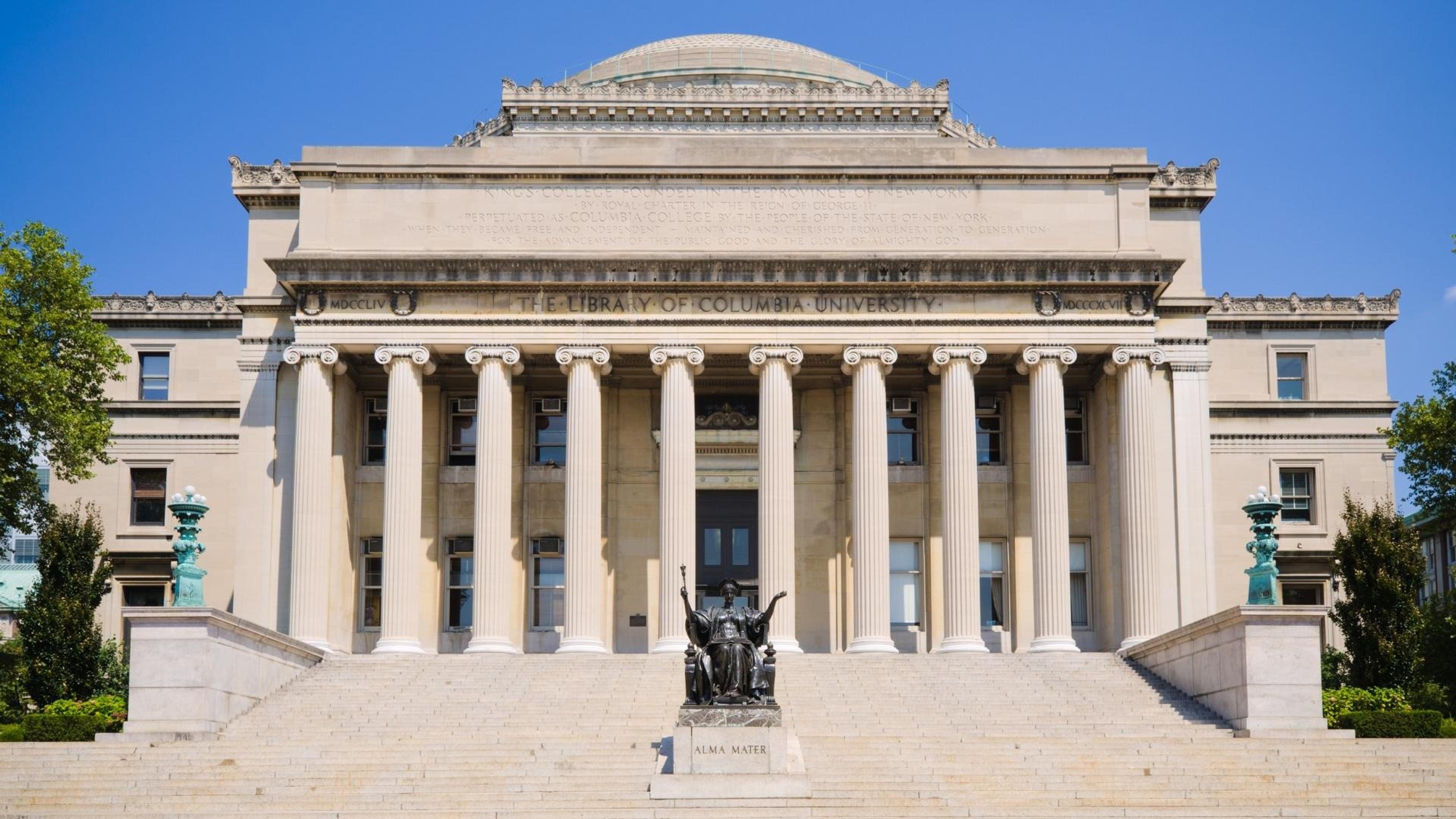
Columbia Business School (CBS) is the graduate business school of Columbia University. Founded in 1916, it is based at the Manhattanville campus in New York City. The full-time MBA offers a flexible curriculum that lets you choose courses based on your career goals. You can also choose between two entry points, August and January.
The full-time Columbia MBA has two entry points:
- August entry: The traditional MBA path. You begin in late summer, complete your first year, pursue a summer internship, and then return for electives in your second year.
- January entry, or J-Term: You begin in January and complete four terms without a traditional summer internship. This path can be a good fit if you plan to return to your current industry, continue working on a venture, or do not need an internship for a career change.
Both groups earn the same MBA degree and come together in the fall of their second year.
CBS also offers an Executive MBA, MBA dual degrees, MS programs, and PhD programs. This guide focuses on the full-time Columbia MBA.
Columbia Business School Acceptance Rate
Columbia Business School does not publish an official MBA acceptance rate. U.S. News reports an acceptance rate of 25.7%, which you can use as a third-party benchmark for the program’s selectivity.
CBS reported 7,477 applications and 982 enrolled students for its 2025 entering class. Because the school does not disclose the number of admission offers it made, you should not calculate an acceptance rate from applications and enrollment alone. The 25.7% figure should therefore be treated as a third-party estimate, not an official CBS statistic.
Regardless of the exact rate, Columbia MBA admissions are highly competitive. The admissions committee evaluates applicants holistically, so no single GPA, test score, industry, or job title guarantees admission.
Read: Columbia MBA Acceptance Rate: Breakdown & Analysis
Columbia MBA Class Profile
The latest published class profile is for the MBA class entering in 2025, which includes both August-entry and January-entry students.
| Class Profile Metric | Latest Published Data |
|---|---|
| Applications Received | 7,477 |
| Total Enrolled | 982 |
| August Entry Class | 758 |
| January Entry Class | 224 |
| Average Undergraduate GPA | 3.6 |
| Average Work Experience | 5 years |
| Women | 46% |
| International Students | 41% |
| U.S. Minorities | 48% |
| Countries Represented | 72 |
You’ll learn alongside classmates with experience in finance, consulting, technology, healthcare, government, and other industries. This diversity can give you opportunities to learn from different perspectives and build connections across industries.
Columbia MBA Test Scores
Columbia accepts the GMAT, GRE, and Executive Assessment. Applicants must submit a valid score when they apply. The school considers scores valid for five years after the test date.
| Test | Latest Published Average | Published Range |
|---|---|---|
| GMAT Exam, 10th Edition | 734 | 610-780 |
| GMAT Focus Edition | 690 | 615-805 |
| GRE Verbal | 163 | 150-170 |
| GRE Quantitative | 163 | 150-170 |
These scores are not minimum requirements. Your overall academic record and work experience also matter when Columbia evaluates your readiness for the MBA program.
Source: Columbia’s MBA Class Profile
Columbia MBA Cost: Tuition and Fees
For a new August entry full-time MBA student in the 2026-27 academic year, Columbia lists tuition of $93,908 and a total first-year budget of $143,030.
| Estmated First-Year Cost, August Entry | 2026-2027 Amount |
|---|---|
| Tuition | $93,908 |
| Mandatory Fees | $6,783 |
| Health Insurance | $5,823 |
| Books and Supplies | $1,290 |
| Food and Housing | $30,231 |
| Personal Expenses | $3,636 |
| Transportation | $1,359 |
| Total First-Year Budget | $143,030 |
This budget reflects a nine-month academic year and includes moderate living expenses. It does not include every possible cost, such as moving expenses, housing deposits, recruiting trips, optional club dues, conferences, or summer living costs.
Tuition and fees typically increase by 2-7% in the second year. Because the 2027-28 figures are not yet published, avoid treating the first-year cost as an exact two-year price.
Source: Columbia’s Current Full-Time MBA Cost of Attendance
Columbia Business School Employment Report
Columbia’s latest employment report covers the Class of 2025. Three months after graduation, 92% of students received job offers and 90% accepted offers. By the end of the reporting period, those figures rose to 96% and 95%, respectively.
The Class of 2025 entered careers across finance, consulting, technology, real estate, healthcare, consumer products, media, and other industries. Finance and consulting accounted for the largest shares of accepted offers at 35.4% and 33.2%, respectively.
| Employment Outcome | Class of 2025 |
|---|---|
| Received offer within three months | 92% |
| Accepted offer within three months | 90% |
| Median base salary | $175,000 |
| Median signing bonus | $30,000 |
| Satisfied or very satisfied with offer | 92.6% |
Top Industries
| Industry | Share of Accepted Offers |
|---|---|
| Financial Services | 35.4% |
| Consulting | 33.2% |
| Technology | 10.2% |
| Other Industries | 21.2% |
Top employers for the Class of 2025 included Boston Consulting Group, McKinsey & Company, JPMorgan Chase, Amazon, PwC, Bain & Company, Deloitte, Goldman Sachs, Bank of America, Evercore, Citigroup, and Lazard.
Source: Columbia Business School’s 2025 Employment Report
Columbia MBA Programs and Degree Options
Full-Time MBA
The full-time MBA is the primary Columbia MBA program for professionals who want to pause full-time work and study in New York City. Applicants can choose August entry or January entry, depending on whether a summer internship fits their career plan.
Executive MBA
The Executive MBA is for experienced professionals who want to continue working while earning an MBA. Executive MBA students earn the same Columbia MBA degree as full-time students, though the schedule and student experience are designed for working professionals.
MBA Dual Degrees
Columbia offers several joint and dual degree options through other Columbia University professional schools.
| Dual Degree | Partner School or Area |
|---|---|
| JD/MBA | Columbia Law School |
| MBAxMS | Columbia Engineering |
| MBA/MPH | Mailman School of Public Health |
| MBA/MIA | School of International and Public Affairs |
| MBA/MD | Vagelos College of Physicians and Surgeons |
| MBA/MS | Journalism |
| MBA/MSW | Social Work |
| MBA/MSUP | Architecture and Urban Planning |
| MBA/DDS | Dental and Oral Surgery |
The JD/MBA and MBAxMS are signature options with integrated application processes. Several other dual degrees require separate applications to Columbia Business School and the partner school.
Learn more about Columbia MBA dual degrees.
Columbia Deferred Enrollment Program
College seniors and eligible graduate students can apply to Columbia’s Deferred Enrollment Program. Admitted students work for two to five years before starting the full-time MBA program.
Applicants must be graduating from a bachelor’s degree program during the current academic year, or completing an eligible graduate degree program they began directly after undergrad. Students enrolled in PhD programs, law school, or medical school are not eligible for deferred enrollment.
The 2027 Deferred Enrollment Program deadline is April 15, 2027, at 11:59 a.m. ET. There is no application fee for eligible deferred applicants.
Source: Columbia’s Deferred Enrollment Program Requirements
Columbia Business School Application Deadlines
August 2027 Entry Deadlines
| Round | Application Deadline | Interview Decision | Final Decision |
|---|---|---|---|
| Round 1 | September 9, 2026, 12:00 p.m. ET | By November 2, 2026 | December 14, 2026 |
| Round 2 | January 5, 2027, 12:00 p.m. ET | By February 17, 2027 | March 24, 2027 |
| Round 3 | March 29, 2027, 12:00 p.m. ET | By April 30, 2027 | May 12, 2027 |
Applicants seeking priority consideration for institutional funding should submit a complete application by Round 1 or Round 2.
January 2027 Entry Deadlines
| Round | Application Deadline | Final Decision |
|---|---|---|
| Round 1 | June 17, 2026, 12:00 p.m. ET | Rolling, no later than July 31, 2026 |
| Round 2 | August 13, 2026, 12:00 p.m. ET | Rolling, no later than October 1, 2026 |
| Round 2 Extended | September 1, 2026, 12:00 p.m. ET | Rolling |
January-entry applications are reviewed on a rolling basis within each round. Applying earlier can give candidates more time to plan for housing, visas, and other logistics.
Check Columbia’s current MBA deadlines before applying
The Columbia Community
Columbia MBA Requirements
A complete CBS application includes the following materials:
- Online application
- Transcripts from every undergraduate and graduate institution attended
- GPA
- GMAT, Executive Assessment, or GRE score
- Professional resume or CV
- Two short-answer questions and three essays
- One letter of recommendation
- $250 application fee, unless you qualify for a waiver
If you are invited to interview, you will complete a virtual interview with a current second-year MBA student, alumnus, or member of the admissions team.
Applicants must have a bachelor’s degree or equivalent from an accredited institution. CBS asks candidates to report their GPA as it appears on their transcript.
Columbia MBA Resume
Submit a professional resume that clearly shows your work experience, career progression, leadership, and achievements. Columbia prefers a one-page resume, although a one- to two-page resume is acceptable.
Keep your bullets focused on results rather than responsibilities. Quantify your impact when possible by showing revenue generated, costs reduced, teams led, customers served, or other measurable outcomes.
Columbia MBA Letter of Recommendation
Columbia requires one letter of recommendation. If you have worked full-time for at least six months, CBS prefers a recommendation from your current supervisor. If that is not possible, you should provide additional context in your application.
Choose someone who can speak directly to your leadership, professional performance, growth, and response to constructive feedback. Applicants should not draft or write their own recommendation.
Read: MBA Recommendation Letter Guide: Examples, Templates, and Writing Tips
Columbia MBA Essays
For August entry, you’ll answer two short-answer questions and three essays.
Short-answer questions
- What is your immediate post-MBA professional goal? (50 characters maximum)
- How do you plan to spend the summer after the first year of the MBA? If in an internship, include the target industry or function. If you plan to work on your own venture, indicate the business focus. (50 characters maximum)
Essay 1
Through your resume and recommendation, we have a clear sense of your professional path to date. What are your career goals over the next three to five years and what is your long-term dream job? (500 words)
Essay 2
CBS currently gives you two options for this 250-word essay. You can either describe a situation where you used one of the five Phillips Pathway for Inclusive Leadership skills and explain your actions and outcome, or share a specific example of how you made a team more collaborative, more inclusive, or fostered a greater sense of community within an organization. (250 words)
Essay 3
We believe Columbia Business School is a special place with a collaborative learning environment in which students feel a sense of belonging, agency, and partnership, academically, culturally, and professionally. How would you co-create your optimal MBA experience at CBS? Please be specific. (250 words)
January-entry applicants
January-entry applicants answer two short-answer questions and three essays. The second short-answer question asks:
- Why do you prefer the January-entry term? (50 characters maximum)
The remaining questions cover your three- to five-year career goals and long-term dream job, an inclusive-leadership or community-building experience, and how you would co-create your optimal MBA experience at CBS. (250 to 500 words, depending on the question)
Optional essay
CBS also offers an optional essay if you need to provide additional context about your application. You can use it to explain an academic issue, employment gap, or unusual personal circumstance that may not be clear elsewhere. The response does not need to be a formal essay, and CBS allows you to use bullet points. The maximum is 500 words.
CBS permits generative AI for idea generation and editing, but the work submitted must be your own. Using AI to generate complete responses violates the Columbia University Honor Code.
Columbia MBA Application Fee and Waivers
The Columbia MBA application fee is $250 and is nonrefundable. Fee waivers are available to eligible full-time students, active-duty U.S. military personnel, eligible displaced persons, and current Peace Corps or Teach For All network participants. Deferred enrollment applicants do not pay an application fee.
Review the official Columbia MBA application requirements.
How to Get Into Columbia Business School
1. Show a Clear Career Direction
You do not need to have every detail of your long-term career planned. You do need a credible reason for pursuing an MBA now, a realistic immediate goal, and a clear explanation of how Columbia will help you move forward.
For August-entry applicants, explain how a summer internship supports your plan. For January-entry applicants, show why you do not need the traditional internship path.
2. Prove Academic Readiness
CBS looks at your undergraduate transcript, GPA, test scores, academic performance, and evidence that you can handle a rigorous MBA classroom. If your GPA or test score is below the class average, use the rest of your application to show academic ability through quantitative work, professional achievements, or additional coursework.
3. Focus on Professional Impact
The admissions committee wants more than a list of duties. Your resume, essays, and recommendation should show the size of the problems you have handled, the people you have influenced, and the impact you have made.
Be specific. Explain the context, your role, the action you took, and the result. A down-to-earth, honest account of a difficult project is usually stronger than a polished story with no proof of impact.
4. Explain Why Columbia
“New York City” is not enough on its own. Research the courses, centers, clubs, faculty, alumni network, and industry access that connect to your goals.
For example, an applicant focused on finance may point to CBS’s finance community, alumni network, and proximity to employers. A candidate interested in entrepreneurship may connect their goals to relevant courses, the Lang Center, startup resources, and the wider Columbia community.
5. Choose the Right Recommender
Pick someone who has closely observed your work and can compare you with other strong professionals. Give them enough time, share the logistics early, and let their letter remain fully their own.
6. Prepare for the Columbia MBA Interview
Columbia interviews are by invitation only. Prepare direct answers to questions about your career path, leadership examples, teamwork, goals, reasons for pursuing an MBA, and reasons for choosing CBS.
Practice aloud until your answers sound natural rather than memorized. Your interview should add depth to your application and show the person behind the resume.
Columbia MBA Curriculum and Student Life
Columbia’s MBA core curriculum includes two full-term courses and eight half-term courses. The first semester builds a shared academic foundation while placing students in clusters that shape much of their first-year classroom and student life experience.
The core includes Financial Accounting, Foundations of Valuation, Managerial Statistics, Strategy Formulation, Managerial Economics, Corporate Finance, Business Analytics, Marketing, Global Economic Environment, Operations Management, and the pre-term leadership course, Lead: People, Teams, Organizations.
Students can take electives beginning in the second term. Core-course exemption exams may allow students with prior knowledge in a subject to replace selected core courses with electives.
The academic experience is built around case discussions, teamwork, practical business problems, and a collaborative learning environment. Outside the classroom, students can join industry clubs, cultural groups, affinity organizations, sports teams, and student groups. Many clubs have executive board roles that give MBA students another place to build leadership and community.
The Manhattanville campus also serves as a center for recruiting, speaker events, research, networking, and student activities. Its New York City location matters most when you use it with a clear focus, whether that means meeting alumni, attending industry events, or building relationships with employers.
Explore the Columbia MBA core curriculum.
Columbia Business School Alumni Network
As a Columbia MBA student, you gain access to a global alumni network of more than 48,000 members. The Columbia Career Network connects you with alumni, faculty, executives, and other professionals for industry and career guidance.
You also benefit from Columbia’s New York location. The Columbia Business School Alumni Club of New York has more than 1,000 members, 22 industry-specific and internal committees, and more than 40 events each year.
If you are targeting finance, consulting, real estate, entrepreneurship, or another New York-based career, you can use these connections to build relationships with professionals in your target industry and strengthen your recruiting efforts.
Get Into Columbia Business School With the Help of Experts
Applying to Columbia Business School is highly competitive. Working with an expert coach can help refine your application, essays, and interview responses.
Top Coaches
Here are three of the most popular MBA admissions consultants for Columbia Business School.
- Victoria R.- Columbia MBA, Forte Fellow | Expert in essays, interviews, & school selection | 20+ CBS admits
- Melanie E. - Ex-McKinsey, CBS MBA | 100+ M7 admits | Former CBS MBA interviewer | Specializes in storytelling & leadership positioning
- London L.- Columbia MBA, Consortium Fellow | Former Accenture Consultant | Expert in career pivots, essays, & interviews
See: The 10 Best MBA Admissions Consultants
Related Articles:
For more resources as you apply to business school, check out these resources:
- Columbia Business School – MBA Waitlist Strategy
- Columbia JD/MBA - Program & Application Overview
- Types of MBA Programs (Exec, Part-Time, Online, 1-Year) & Which One is Right for You
- Top 25 Business Schools' Acceptance Rates & Class Profiles (2026)
FAQs
Is Columbia Business School an Ivy League business school?
- Yes. Columbia Business School is part of Columbia University, which is a member of the Ivy League. The MBA program is located at Columbia’s Manhattanville campus in New York City.
What is Columbia Business School’s MBA acceptance rate?
- Columbia does not publish an official MBA acceptance rate. The school publishes application and enrollment totals, but it does not disclose how many applicants receive admission offers.
How much does the Columbia MBA cost?
- For a new August-entry student in 2026-27, tuition is $93,908 and the published first-year cost of attendance is $143,030. That total includes tuition, fees, health insurance, books, housing, food, transportation, and personal expenses.
Does Columbia require the GMAT or GRE?
- Columbia requires applicants to submit a valid GMAT, GRE, or Executive Assessment score. The admissions team accepts self-reported scores with the application, but admitted students must submit official scores.
Is the Columbia January entry MBA right for career switchers?
- It can be, but applicants should think carefully about the missing traditional summer internship. The January term is often a better fit for students returning to their industry, continuing a business, or pursuing a path that does not depend on internship recruiting.